In twelve weeks you will hire your first AI employee, hand off one real function to a human, and take five working days completely unreachable, and find out whether the business runs without you.
Get an inside look at this module — the working drawing, free.
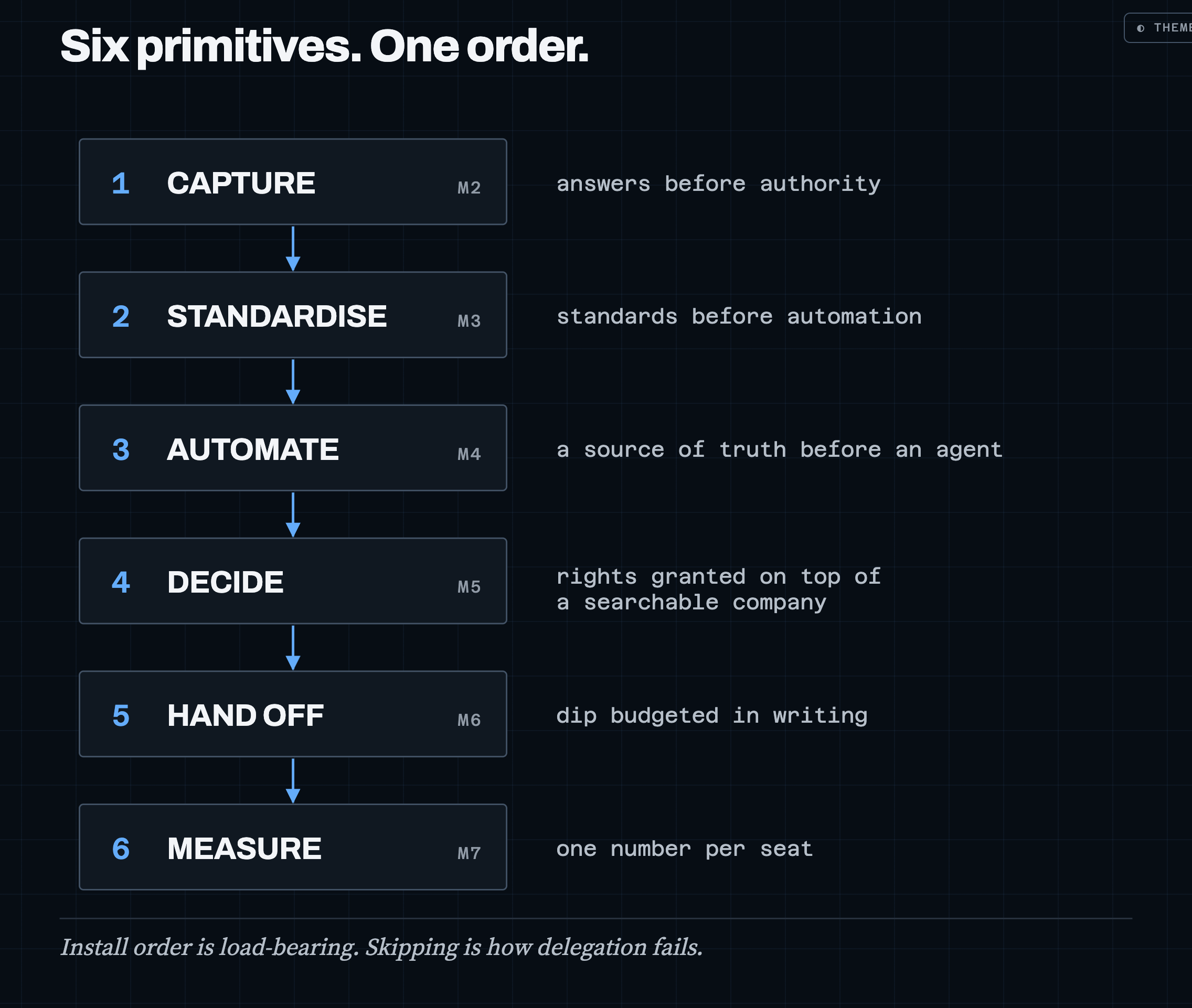
Capture, standardise, automate, decide, hand off, measure. The list is not the point. The order is. Only one constraint binds at a time, and that sentence is Eliyahu Goldratt's, the Theory of Constraints, The Goal, 1984. The install order, and the router that finds your constraint in week one, are ours.
At least twenty entries, each titled as the question in the asker's own words, the answer on the first line, reachable in two taps from where your team already works. A question with a published answer stops being a question for you.
By Friday of week four it is live on the number your customers actually message, answering from your own index and escalating your dead-zone list without exception. With it comes a 72-hour escalation log: every escalation recorded, including the ones it escalated that it could have handled. Rung zero is ours. The Replacement Ladder above it is Dan Martell's, Buy Back Your Time, 2023.
A matrix of real named decisions from your business, not categories, graded on reversibility and blast radius, published where the work happens and read by every person it applies to. Not sent to them. Read by them. Reversibility as a decision axis is Jeff Bezos's, from Amazon's letter to shareholders for 2015. Pairing it with blast radius is ours.
A named function, a named person, work that has actually changed hands, and a signed dip budget carrying two dated signatures and an abort criterion written in full words. Abort on slope, not level: low and rising is on plan. The first brief is built on 10-80-10, which is John C. Maxwell's, 2014, popularised for founders by Dan Martell in Buy Back Your Time, 2023. The J-curve and the dip budget are ours.
One number per seat, one named owner who could explain a red without turning to anyone, and a red line the owner wrote before the first measurement. The phrase one number per seat, and the word seat, are Gino Wickman's, Traction, 2007. Then five working days completely unreachable, to find out whether the business runs without you, and a re-scored Founder Dependency Index sitting beside your week-zero baseline. Two scores, twelve weeks apart, on one image.
9 modules, each ending in a deliverable.
Singapore service businesses turning over roughly S$300K to S$2M, with teams of two to ten. That is a targeting choice rather than a claim about how many such businesses exist; we have not counted them and will not pretend to have. The practical test is simpler than the revenue band: if your staff and your customers both message you on a Sunday evening because you happen to be the only person who knows the answer, and almost none of those messages is actually a decision, you are the reader this was built for. Two people is not too small. It is the ideal size, and the reason is mechanical rather than measured: every standard you write has to survive one interpretation per head, so two people is two readings of the same sentence and twenty is twenty. We have never run this on a team of twenty, so we are not going to tell you what that costs in weeks. Bespoke work is not a disqualifier either. If every job really is different, your constraint is retrieval rather than process, and Module 2 becomes your deep week. Bespoke businesses still answer the same twenty questions every week, and those answers still live only in your head.
Four kinds of founder, and we would rather say so than take the money. If you are pre-revenue, close the page. Extraction is a problem you earn by having demand you cannot personally serve; if nobody is buying yet you have a demand constraint, and every hour spent installing operating primitives is an hour not spent finding out whether anyone wants the thing. If you are solo with no staff at all, close it too. Modules 5 through 8 have nothing to move: decision rights need somebody to grant them to, a handoff needs somebody to hand to, and a scoreboard with one seat on it is a diary. The specific trap we would rather warn you about than profit from is that you could work happily through the first two modules and only discover in week five that there is nobody to hand anything to. If you want it done for you, a vendor build is the right purchase. It is legitimate, and it is not this. And if you already know you will run the interruption log for two days and then stop, nothing downstream works. Your binding constraint and your personalised module map are calculated from that log, and so is everything that comes after them.
No AI experience, and no code. The agent build is configuration. If you can set up a WhatsApp Business profile and edit a document, you can do Module 4, and it is built on camera end to end, with the recording yours. The parts that actually go wrong are not technical. They are scoping decisions: what the agent is allowed to handle, what it must escalate, and who it escalates to by name. That is where the module spends its time. Two lists get written before you touch a tool, handles and escalates, and anything you cannot confidently put on the first list goes on the second. The default is deliberately conservative. Escalation then needs a named destination, a person or an inbox somebody owns, because escalates to the team is not a destination.
Two things are designed for exactly that. First, every module tells you what to cut rather than leaving you to guess: twelve answers in your index instead of twenty, three question types live instead of twenty. Second, we tell you which modules to skim. In week one you calculate your own binding constraint from your own log and get a personalised map of which modules are deep for you and which you watch without doing the deep exercise. The principle underneath that is Eliyahu Goldratt's, from The Goal in 1984: only one constraint binds at a time. The router that turns it into your specific route is ours. Skim, not skip, and there are two fixed points whatever your constraint. Nobody skims Module 1, because every route out of the course is calculated from what you produce that week. And nobody skips the Unreachable Week at the end. The calendar has room built into it as well. Twelve weeks is six taught weeks followed by six weeks of supported install, because every handoff dips before it climbs, and a course that ends when the teaching ends leaves you alone inside the dip.
Twenty-two things that live in the business after the video ends, plus fourteen fill-in templates and the working drawing that puts the whole system on one sheet. Among them: an interruption log and a dated baseline score on the Founder Dependency Index, which is our instrument, built on six axes. A ranked dependency list and one binding constraint written down, not a shortlist. A live answer index of at least twenty entries, each titled as the question in the asker's own words, with a measured before and after on lookup volume. Three published definitions of done a stranger could apply. A live agent on the number your customers already message, and a 72 hour escalation log. A published decision matrix populated with real named decisions, graded partly on reversibility, an axis credited to Jeff Bezos and Amazon's letter to shareholders for 2015. One handoff in flight, with a signed dip budget and written abort criteria. A published scoreboard carrying one number per seat, a phrase and a word taken from Gino Wickman's Traction, 2007. A cash dashboard, a re-scored index with a per-axis delta sitting beside your week zero baseline, and a next quarter list derived from what broke while you were unreachable. Every one of them is graded against a written list of what makes it not done, which is the list worth reading.
Ask Boss Everything, the twelve weeks that stop them, is a build programme, and there are four things it deliberately is not. It is not done for you. Nobody here configures your agent, writes your answer index or runs your log; if you want that, buy a vendor build. It does not file your Productivity Solutions Grant application and it is not grant advisory work. Module 4 teaches the rules that decide eligibility, not the portal form. It is not WSQ-accredited, so it carries no accreditation and no certificate. And it does not promise that your business will run without you. It promises that you will hire your first AI employee, hand off one real function to a human, and take five working days completely unreachable, and find out whether the business runs without you. That last clause is the honest one. What breaks in that week is not a failure; it is your next quarter's build list, delivered by the business itself in priority order, and nobody can produce that list for you. The only instrument that generates it is your absence.
No. We have none, and we are not going to manufacture any. No cohort has run. There are no students, no client case studies, no testimonials, no before and after revenue figures and no income claims anywhere in this material, and any page that shows you those without having run a cohort has invented them. What we offer instead is proof of mechanism: the agent working on our own instance, and the part nobody else shows you, the agent reaching the edge of what it knows and handing over to a person. You cannot judge software by what it answers. You judge it by what it does when it does not know. When real measurements exist they will be labelled as measured, and they will include the ones that went backwards.
You can, and Module 2 shows you exactly how to use a general purpose model for the capture step. The problem is not the tool, it is the order. A model with no source of truth behind it does not fail loudly. It invents your business, fluently and confidently, to strangers, and you find out when a customer does. That is why Module 4, the agent build, is gated behind Module 2's artifact: no answer index, no build. The course is the part that makes a tool safe to point at customers, plus the rule that decides what you are allowed to hand it in the first place. Never delegate work whose output costs more to verify than to produce. Dan Martell's rule, in Buy Back Your Time, 2023, is that eighty per cent done by somebody else is not merely acceptable but excellent. True, with a boundary he does not state, and the boundary is ours: eighty per cent is fine exactly when checking is cheap. An eighty per cent correct opening-hours reply you spot instantly. An eighty per cent correct quotation is a liability with your name on it.
A WhatsApp Business account and a Business Solution Provider; somewhere to hold the answer index, with four options compared honestly and their trade-offs stated; a transcription tool; and a general purpose model for the capture step. Whatever holds your calendar today stays exactly as it is, because two changes at once means you cannot tell which one broke. Costs are given as bands rather than prices, because they move. A workspace tool is around US$10 per user per month at the paid tier, and a functional WhatsApp agent runs in the low hundreds of Singapore dollars a month depending on volume and provider. Verify both yourself before you commit; vendor pricing changes and we are not going to pretend otherwise. Two Singapore mechanics you cannot skip. Some providers pass Meta's message fees through at cost and some add a markup of roughly twenty per cent, so ask which, in those words, and get it in writing before you sign. And Meta moved to per-message pricing on 1 July 2025, with service replies inside the twenty-four-hour customer window becoming chargeable from 1 October 2026. Check that date against today's, and do not build a cost model on free replies. Module 4 also teaches PDPA properly: consent and notification at the point of collection, the Transfer Limitation Obligation, which catches nearly everyone because nearly every AI stack hosts data offshore, and three questions to ask any vendor. You finish knowing where your customer data physically lives.
SkillsFuture Credit does not apply, because this course is not WSQ-accredited. We state that unprompted rather than wait to be asked, because pretending otherwise would be both false and a problem under the Consumer Protection (Fair Trading) Act. If subsidy is the deciding factor for you, the WSQ-accredited AI literacy courses are heavily subsidised and genuinely good value, and they teach tools. Check the current funding rate on SkillsFuture's own site rather than take a percentage from us; we have not sourced one, so we are not printing one. The Productivity Solutions Grant is a different matter. It funds the tools, up to 50 per cent and capped at S$30,000 a year, where the solution is on the pre-approved list, so check yours rather than assume it. It does not fund this course. The rule that costs founders real money is the sequence: you apply through the Business Grants Portal before you sign and before you pay. Paying first and applying afterwards is how a business in this band donates a few thousand dollars to nobody.
No, and anyone who tells you it does is selling. Nobody comes off your payroll, because most founders reading this have not made that hire yet, which is rather the point. Filling the empty first rung, front desk, inbox and calendar, runs roughly S$42,000 a year in Singapore once you count base pay, employer CPF at up to seventeen per cent for employees aged fifty-five and below above the wage floor, and the customary annual wage supplement. That figure is a cost comparison and nothing more. It is not a saving and it is not a promised return. What it explains is why that rung keeps getting postponed: not a decision you have been avoiding, one you could not afford. So we add a rung below it. The ladder itself is Dan Martell's, from Buy Back Your Time, 2023, and its strict order is the idea. Rung zero, the AI employee below his first rung, is ours. It does not go first because it saves the most hours; it will not. It goes first because it raises the ceiling of every hire above it. The same person, on the same salary, working with a live answer index and an agent that already absorbs the routine traffic, handles materially more business. That is what rung zero buys. Not hours. Headroom.
Cohort one is capped at twelve seats and runs at a founding rate. Nothing is on sale yet and there is no checkout on this page. Register your interest and we will tell you when seats open.